
Why I LOVE Blind Tasting!
And what it taught me about the “hidden story” waiting to be unlocked in every bottle...

If you want controversy in wine, just ask someone’s opinion on blind tasting.
Some people sneer at it, thinking it’s nothing more than a parlor trick with no purpose. Others see it as the only way to truly appreciate wine. And some think it’s a mythic power of the Sommelier that no mere mortal could ever achieve.
What I’ve discovered is it is a learnable skill that has greatly enhanced my enjoyment not only of wine, but of other food and drink as well
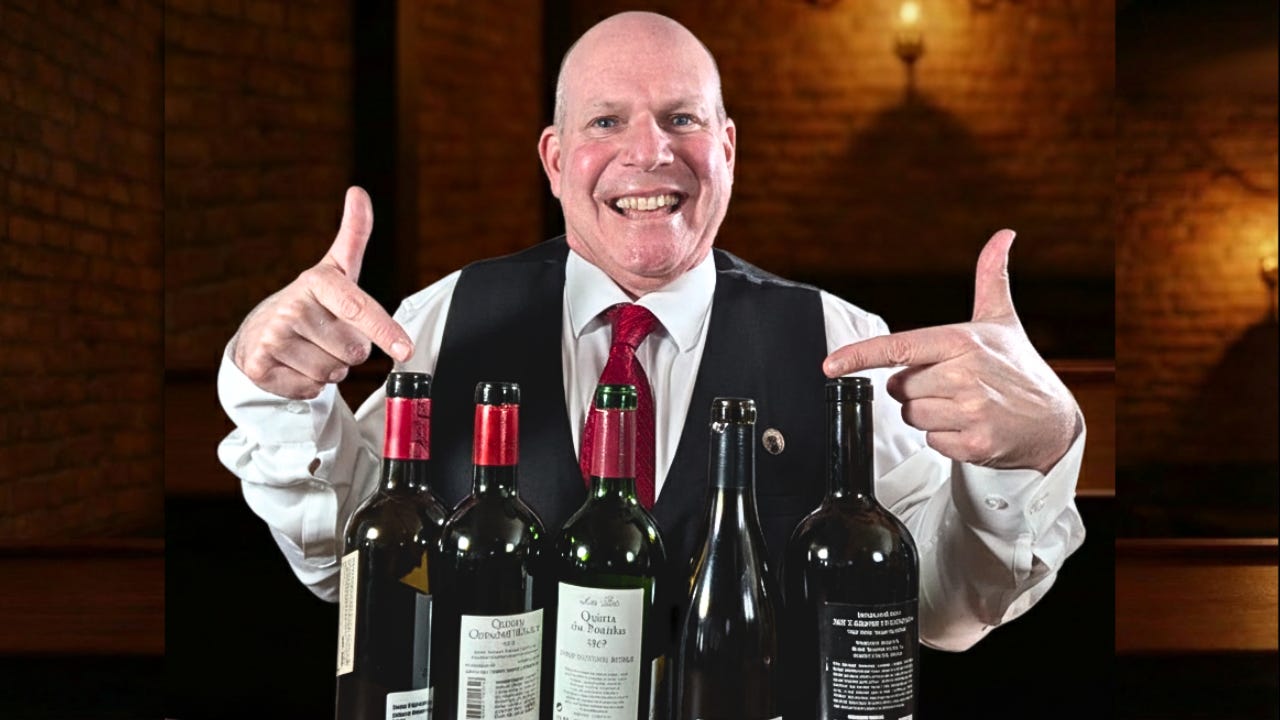
I am not an ace blind taster. I learned how to do it at the Certified Sommelier level where you have to identify grapes, regions, and climate. I aspire to do it at the Advanced Sommelier level where you have to identify a heck of a lot more than that, but that is a multi-year project, something I want to do for personal enjoyment. I am not crazy enough to want to do it at the Master Sommelier level.
First things, first. You can learn to blind taste at the Certified Sommelier level in a relatively short amount of time. It is a skill anyone can learn if they follow a process. But, Arthur C. Clarke’s third law applies- “Any sufficiently advanced technology is indistinguishable from magic,” and a Sommelier tasting a wine, and correctly calling grape, vintage, region, producer et al appears as magic to most wine drinkers. After all, when they taste wine, all they taste is “wine.” It can be hard to believe that it is merely a skill to be learned in a scientific manner, that it is technology, not magic.
The Court of Master Sommeliers does not discourage the public from thinking it is magic, nor should they. It is a fun part of the overall wine experience, and I immensely enjoy talking to Advanced and Master Somms about blind tasting because while I logically know it is a skill they learned, to me there IS magic in what they can do. After all, technology by itself is boring and scientific, but add just a hint of magic, and it becomes exciting.
When I first attended the Court of Master Sommeliers Intro event in Houston in late 2022, I came out thinking there was no way I could ever do blind tasting. So I attended their Deductive Tasting Method event in Houston a month later, and came out thinking there was a very slight chance I could do it. It still seemed more magic than science to me.
But, if I wanted to get the certification, I had to learn blind tasting, and I had to learn service. I had no desire to learn how to carry a tray, but if I wanted the Certification, I had to learn how. I also didn’t want to learn about craft cocktails or vermouth or beer or sake or amaros, but if I wanted the certification, I had to learn them. It’s a pretty cut and dried proposition. So I decided to buckle down and learn them all. You’re either a serious person or you’re not.
Luckily I came across an Advanced Sommelier offering a prep course for the Certified exam, and part of the course was a one on one tasting session with her, going through four different wines, making your calls- structure (acid, tannin, body, alcohol), Non Fruit Indicators (pyrazine, earth, rotundone, oak and so on), aromas and flavors, and fruit character (underripe, ripe, overripe, jammy). There is nothing more valuable than a guide, even for a one time session, when it comes to learning blind tasting.
The grapes are limited to 20 or “examinable grapes,” the most popular grape varieties for classic wines- you’re not going to get Godello or Nerello Mascalese on the exam (I like both), and the key is to know your “theory” so you can link it to what you see, taste, and smell in the glass. “Theory,” is just the term for knowledge about the grapes, how climate/weather affects them, and the characteristics of different regions. For example, Syrah in the Northern Rhone will be medium bodied with ripe fruit character, while Syrah (Shiraz) in Australia will generally be full bodied with overripe, even jammy character. Both will have notes of black pepper from rotundone.
Blind tasting is not a process of identification, it’s a process of elimination. If I look at a wine, notice it is a light ruby color, and I can see my hand through it, then I can pretty much eliminate Cabernet Sauvignon, and whittle down the list based on what I do NOT taste and smell. If I get earth in it, it’s probably not New World, so I’ve whittled down my regions. You keep “whittling” until you only have a few choices left, then make your call based on subtle differences- or best guess.
It took me three months to start making consistently good calls. I bought 30 representative wines, a Coravin with a lot of capsules, and every other day my Mother set up 2 whites and 2 reds, each in a brown bag secured by a rubber band. I got two ounces of each wine, and set the timer to 30 minutes. Then I went through the Certified Sommelier tasting grid, as instructed by the prep course.
For the first few weeks my calls were embarrassingly bad. For some reason I called a Chardonnay a Riesling, and a Malbec a Pinot Noir. But after each tasting I did something that is the key to learning blind tasting. I kept a journal of each wine I tasted, and WHY I made the calls I did. Whenever I made a bad call, I immediately tasted the wine I thought it was, and wrote down the differences between the two.
That was the most valuable thing I did. It was the process that brought my theory into alignment with my tasting. For example, I kept making the mistake of calling a California Zinfandel a California Merlot. Both have a warm climate, jammy fruit character. But when I tasted them side by side after reviewing my theory, I noticed the Zinfandel had a “raisney” fruit character from uneven ripening, as well as a unique oak characteristic (many are aged for a bit in both American and French Oak). I noticed the Merlot had faint undertones of tobacco and bell pepper from Pyrazine, the chemical found in green bell pepper that is present in all six Bordeaux grape varieties, but not in Zinfandel.
In order to learn blind tasting, I had to follow it up with “sighted tasting,” after making bad calls. I cycled through all 30 wines many times during that three month period, removing the New Zealand Sauvignon Blanc, the Gewurztraminer, and the Kabinett Riesling. Those were too easy, and without them I could focus on the hard ones- Chablis, Macon Villages White Burgundy, Albarino, and Pinot Grigio.
I tasted, I made my calls, took bags off bottles, wrote about my calls, and tasted sighted against my bad calls. Then wrote some more. After three months I was consistently hitting 75%, and sometimes 100%. The frequency of my bad calls dropped dramatically, and I was able to accurately justify my good calls.
There was no magic to this process. It was good ol’ fashioned US Navy drilling. You drill and you drill and you drill some more until it is second nature. You drill until you are bored stiff. And then you drill some more. You train like you fight, and when it comes time for the exam, you go in understanding you don’t rise to the level of your ability, you sink to the level of your training. That’s the least magical thing in the world.
I wanted to make the exam an “easy training day,” just another repetition of a mind numbing drill, and it was pretty much that. No surprises, no intrigue, just another drill. No magic, just technology. That’s how it went.
Along the way, I discovered I loved blind tasting. I loved going through the grid because it told the story of the wine. My mind picked up flavors and aromas I could now interpret, knowing the grape, climate, and region. Now when I drink wine, the story unfolds, the story that was always there that I missed before. Where is it from? How was it made? What was the weather like that year?
When it comes to “sighted tasting,” you have to be careful because if you know your theory, your mind starts filling in the blanks before you’ve examined, tasted, and nosed it. For example, many Premier Cru Chablis do not see oak, and have no malo. When I blind tasted the one I had in rotation, I thought I got a touch of malo and a bit of oak. Reading up on it, sure enough, there was some oak and some malo in the tech sheet. Blind, I picked them up. Sighted, I thought, “it’s Premier Cru Chablis, why would there be oak or malo?”
Learning to blind taste at the Certified Sommelier level unlocked the hidden story that’s in each bottle of wine for me. Even though I have an idea of what to expect when I drink a bottle, I’ve learned to set my expectations aside, and pay attention to structure, non-fruit indicators, aromas, and flavors in the context of their story.
When you know the story, you can tell it to your guests, truly bringing the wine to life for them. And that’s always been the magic of wine to me, the story that it tells.
Learning to blind taste brought that story to life.
I thoroughly enjoyed this article. I love wine and you made tasting it very accessible and understandable. Years ago, I wanted to learn the way you have. It felt too cumbersome. So, I just pick my favorite and enjoy it. Now, I think I will become an explorer with my eyes closed and taste buds ready. Thank you.